
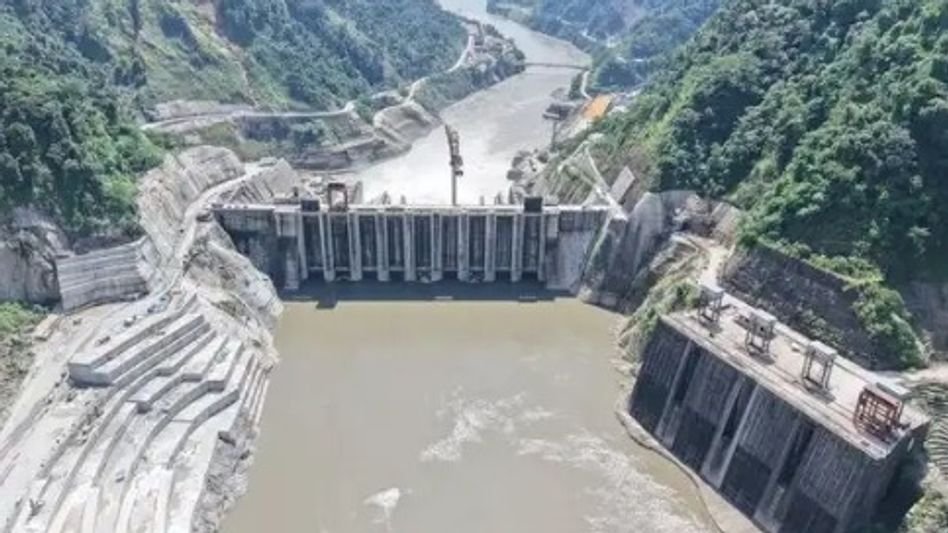
The Subansiri Lower Hydroelectric Project has cleared a massive hurdle, and the countdown to its full 2,000-MW power delivery just got a lot more real.
Something significant happened on the banks of the Subansiri River this week — and it didn’t involve any ceremony or ribbon-cutting. Workers at the 2,000-MW Subansiri Lower Hydroelectric Project quietly achieved what engineers call a defining electro-mechanical milestone: the successful lowering of a 395-metric-tonne generator stator belonging to Unit 7. To put that in perspective, you’re talking about a single component heavier than most commercial aircraft, carefully maneuvered into place inside a mountain powerhouse. It’s the kind of work that rarely makes headlines, but it absolutely should.
Officials confirmed the development on October 1, and Arunachal Pradesh Deputy Chief Minister Chowna Mein — who also holds the Power and Hydropower portfolios — didn’t hold back his enthusiasm on social media. “This critical milestone in the electro-mechanical works brings the project closer to commissioning Unit 7 and, subsequently, its full installed capacity of 2,000 MW,” Mein said. For a project that has faced decades of delays, legal battles, and environmental pushback, that statement carries real weight.
The Subansiri Lower Hydroelectric Project sits along the Arunachal Pradesh-Assam border, developed by the National Hydroelectric Power Corporation, better known as NHPC. The design is straightforward but ambitious — eight generating units, each rated at 250 MW, for a combined installed capacity of 2,000 MW. When it runs at full tilt, the project is projected to pump out roughly 7,422 million units of electricity every single year. That’s not just numbers on paper. That’s homes lit up, industries powered, and an energy-hungry Northeast region getting a much-needed backbone.
Progress has been steady, if not spectacular. Two generating units were commissioned earlier this year, and by March 20, the third unit was declared commercially operational — bringing the project’s total commissioned capacity to 750 MW. Getting from 750 MW to 2,000 MW is still a climb, but the successful lowering of Unit 7’s stator signals that the climb is very much on track.
The Union Power Ministry had earlier set a December deadline for the complete project. That timeline suddenly feels a lot less ambitious now. With Unit 7 making serious headway on the electro-mechanical side, commissioning activity is expected to pick up pace in the months ahead. Units don’t just appear overnight — the stator lowering is one of the most technically demanding phases of the installation process, and clearing it means the rest of the unit assembly can move forward with fewer complications.
It’s worth pausing to appreciate what this project means for the region. Arunachal Pradesh sits atop enormous hydropower potential — some estimates put it at over 50,000 MW — yet barely a fraction of that has been tapped. The Subansiri project, for all the controversy it has weathered over the years, is proof that with enough persistence, these mountains can genuinely power a nation.
If December holds as the target, India is about to gain one of its most powerful river-based energy sources yet. And somewhere beneath the hills of Subansiri, a 395-tonne stator is already doing its part.