
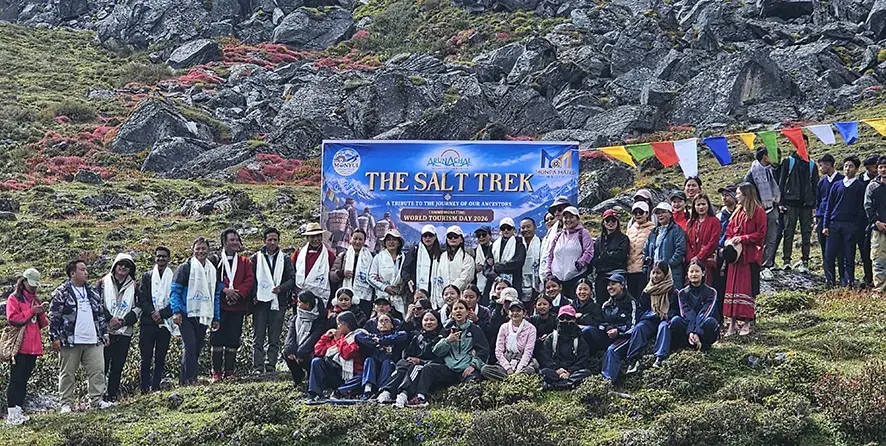
There are some stories a mountain never forgets. And on Sunday, over a hundred people walked into one of them.
The ‘Salt Trek’ — a heritage trekking initiative that retraces the ancient trade route once used by Monpa forefathers to bring salt from Tibet — was flagged off in Tawang on September 20 by local MLA Namgey Tsering. It wasn’t just a walk. It was a reckoning. A quiet, powerful act of remembering.
The nearly 5.5-kilometre route began at Griptsang Lake near Nagula and ended at Chhu-shet Gyengo near Klemta Lake — a stretch that forms just one small section of the much longer, gruelling path that the ancestors of the Monpa community once covered on foot, carrying goods through high-altitude passes, bitter cold, heavy snowfall and relentless mountain weather. They did all of that for something as basic and essential as salt.
Think about that for a moment.
Among the participants were Tawang ZPM Sonam Nordzin, officers of the Indian Army, students, youths, and trekking enthusiasts. Together, they walked a path that most of the world has never heard of — and that the younger generation was at real risk of forgetting entirely.
Along the way, Gaon Burahs Dorjee Tsering and Phurpa Gombu offered something no GPS can give you — they shared living memory. They spoke about the history of the ancient route, the pilgrimage sites dotted along it, and why it matters deeply to preserve the traditional local names of lakes, landmarks and places before those names disappear with the people who still carry them. Oral histories don’t survive on their own. They need voices, and those voices are dwindling.
MLA Tsering, addressing the gathering, called it a historic and meaningful occasion. He admitted he had personally trekked a section of the route a year ago, driven by a desire to understand its significance firsthand. He urged the youth to take pride in their cultural legacy and asked everyone present to offer a mindful tribute to their forefathers — not just through the walk, but through understanding the weight of what those ancestors endured.
The organisers were particular about one thing: the trek should leave no trace. Participants were reminded to carry back every piece of waste and keep the fragile high-altitude landscape exactly as they found it. That, too, felt like a form of respect.
At the end of the trek, each participant who completed the route was felicitated with a traditional khada. A collection of ancestral objects was also put on display — baskets, horse saddles, walking sticks, a traditional matchbox, silver coins, and samples of white and rock salt that the forefathers once traded. For many of the younger walkers, it was likely the first time they had seen these objects up close. The weight of history can be surprisingly light when it fits in your hand.
The initiative was organised by the Monyul Heritage Tourism and Winter Sports Society, in collaboration with the Department of Tourism, Tawang, and Monpa Media Mates, with support from the Indian Army — fittingly, as part of World Tourism Day commemorations.
Tawang has glaciers, monasteries and landscapes that can take your breath away. But perhaps its most extraordinary asset is this — a living cultural memory that, if nurtured carefully, could become one of the most powerful heritage tourism corridors in the entire Northeast. The Salt Trek is a beginning. The ancestors walked so their children wouldn’t have to suffer. Now, the children walk so they never forget that they did.