
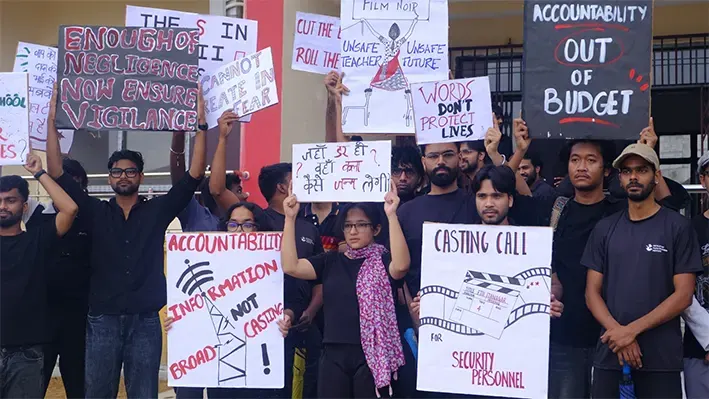
ITANAGAR, September 20, 2026: Classes have come to a standstill at the Film and Television Institute of India (FTII), Itanagar, after students alleged that several of their peers and a faculty member were assaulted by local individuals, triggering an ongoing “academic halt” on campus.
The Students’ Council said the protest began on September 17 and will continue until authorities take concrete and time-bound steps to address what students describe as growing concerns over safety, security and repeated incidents of intimidation.
The incident that sparked the latest protest reportedly took place on the evening of September 16. According to the Students’ Council, three students were engaged in academic assignments when a group of local individuals allegedly approached them and started an unprovoked verbal confrontation.
What began as a confrontation quickly turned physical, the council said. One of the students was allegedly assaulted with a stick. Dominic Sangma, the institute’s screenwriting department head and a two-time National Award-winning faculty member, reportedly intervened after seeing the situation escalate. The council alleged that he too was beaten during the incident.
The students further alleged that another student, who was not involved in the original dispute, was later attacked on the head with a bamboo stick without provocation. Students and institute authorities who tried to intervene, including security personnel, were also allegedly subjected to abuse and threats, according to the council.
For students, the incident appears to have crossed a line that had already been under discussion for months. The Students’ Council said female students in particular are feeling extremely unsafe and are worried about their lives and wellbeing amid what it described as repeated threats, harassment, intimidation and now physical violence.
The council also pointed to earlier complaints about unauthorised entry into the campus, aggressive behaviour around students and inadequate security arrangements. These concerns, it said, had already been raised with the administration, including demands for stronger security and the deployment of Central Industrial Security Force (CISF) personnel.
According to the students, institute communications issued on May 5 and May 6, 2025 had indicated that CISF personnel were ready for deployment. The deployment, however, allegedly remained pending because accommodation arrangements had not been completed.
More than a year later, the students say the problem remains unresolved.
That delay has become one of the central issues behind the academic halt. From the students’ perspective, the latest assault is not an isolated disagreement but the latest point in a longer-running security dispute. They are now demanding action that goes beyond assurances and want a clear timeline for implementation.
Among their key demands is an immediate strengthening of security both inside and around the campus. The students have called for CISF deployment and the construction of a police outpost near the institute. They believe a permanent law-and-order presence close to the campus is necessary to respond to incidents quickly and to reassure students and staff.
The Students’ Council has also called for an internal committee made up of faculty members and students to monitor the legal proceedings connected to the incident. The committee, according to the council, should ensure that the process is followed fairly and transparently.
Another demand is the creation of a permanent communication committee that would maintain regular dialogue between the institute and local residents. That proposal reflects a second concern running through the students’ complaints: the need to prevent tensions between the campus community and people living nearby from repeatedly escalating into confrontations.
The students are also seeking an in-person meeting with senior officials, including the vice-chancellor of the Satyajit Ray Film and Television Institute (SRFTI), the joint secretary, the district magistrate and the deputy commissioner, along with student representatives.
The demand for direct intervention from senior authorities underlines the seriousness with which the students are viewing the situation. For an institute dedicated to film and television education, academic work depends heavily on an environment where students can attend classes, work on productions and complete assignments without fear of intimidation or violence.
An academic halt affects more than classroom attendance. Film students often work on tightly coordinated projects involving writing, production, equipment, locations and teams. Any prolonged disruption can potentially affect schedules, assignments and the broader academic routine.
At the heart of the protest, however, is a simpler demand: safety.
The Students’ Council has made it clear that it does not intend to resume normal academic activity until it sees effective measures being put in place. “Let us learn without fear,” the council said, capturing the central message behind the protest.
The allegations made by the students now place the responsibility on the concerned authorities to address the incident, establish the facts through due process and respond to the wider security concerns raised by the campus community.
What happens next will matter not only for the immediate dispute, but also for the confidence students place in the institute’s ability to protect them. For those currently studying at FTII Itanagar, the issue is no longer simply about returning to class. It is about whether they can return to campus feeling safe enough to learn, create and work without fear.