
Eighty-five school students walked into a university lab. What they left with could change their futures.
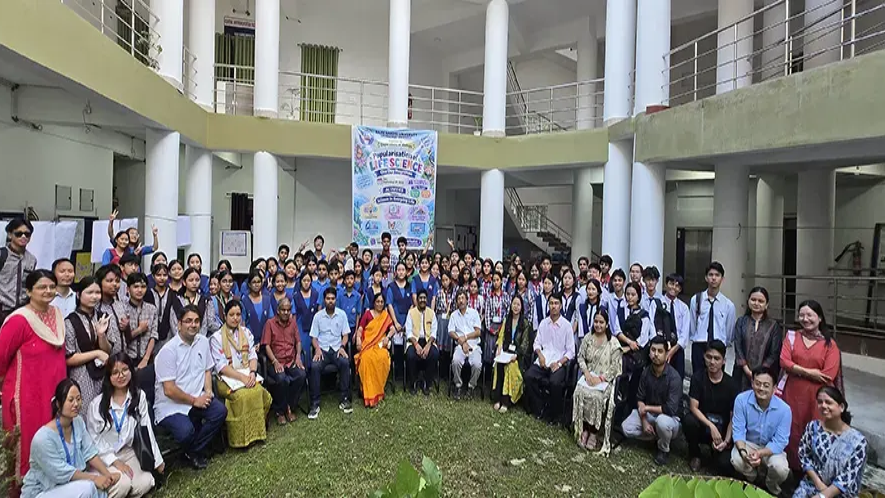
RONO HILLS, September 28 — On a Saturday morning, the zoology department of Rajiv Gandhi University (RGU) was buzzing with something it doesn’t always see — the unfiltered energy of teenagers discovering science for the first time. Eighty-five students from Classes 7 to 10, drawn from four schools across the region, arrived at the Rono Hills campus for a programme that the department had crafted with a clear purpose: bring the university to the children before they even think of coming to it themselves.
The event, themed ‘Popularisation of Life Science’, was designed as a social outreach and sensitisation initiative — a way to let young minds experience what university research actually looks like, not just read about it in a textbook. The participating schools included Vivekananda Kendra Vidyalaya from Nirjuli, Kendriya Vidyalaya from the NERIST campus, Senior Secondary School from the RGU campus itself, and Alphabet Public School from Amba, Doimukh.
The day didn’t begin with lectures. It started with creation. Students were split into two groups — Classes 7-8 and Classes 9-10 — and put to work on poster-making and model-making competitions centred on the theme ‘Science in Everyday Life’. By the end, they had collectively produced 52 posters and 15 models, each one explained by the students themselves to judges and visitors. There’s something powerful about watching a twelve-year-old defend their own scientific idea to an adult. These kids did exactly that.
A quiz competition followed, testing knowledge across life science and general science — and by all accounts, it pulled in some fierce participation. The competitive spirit in the room, by multiple accounts, was real.
Then came the tour. Students were walked through the department’s laboratories and museum collections — the kind of hands-on exposure that no classroom lesson can replicate. Seeing preserved specimens, equipment, and ongoing research up close has a way of making the abstract suddenly feel possible.
RGU Vice-Chancellor Prof Shivraj, who attended the programme, praised the zoology department’s initiative and didn’t mince words about wanting more of it. He made it clear that future editions should rope in a larger number of schools. The university, he suggested, shouldn’t wait for students to come to it — it should go to them first.
Zoology Head of Department Prof DN Das spoke on what he called “the beauty of life science and zoology,” framing it as the study of the entire living world — from the smallest insect crawling through soil to the largest animal on earth. It’s the kind of perspective that can genuinely shift how a young student sees the subject.
Dr Arnab Ghosh, who served as organising secretary and convener for the event, placed the programme within a broader national vision. He pointed out that reaching young students early, showing them what research and higher education look like, is a core component of the National Education Policy (NEP) 2020. “Engagements like this would plant the seed of scientific curiosity in young minds,” he said — and he’s right. Seeds planted early grow the deepest roots.
The day wrapped up with the Vice-Chancellor personally handing out certificates and medals to prize winners. A small gesture, but one that means a great deal when you’re fifteen and someone important tells you that your work matters.
Somewhere in that room on Saturday was a student who had never thought of themselves as a scientist. They might think differently now.