
Every year, when September arrives in Arunachal Pradesh, something quietly magical happens across the hills of East Siang and Upper Siang. The air fills with the rhythm of Ponung songs, families gather in their homesteads, prayers rise toward the sun and moon, and the Adi community marks another Solung — a festival that is as much about gratitude as it is about harvest.
This year, Arunachal Pradesh Chief Minister Pema Khandu made sure his voice was part of that moment too.
On September 1, the first day of Solung 2026, CM Khandu extended warm greetings to the Adi community on social media, reaching out to his “Adi brothers and sisters” in a message that felt less like a political formality and more like a genuine embrace. He prayed for prosperity, peace, happiness and good health for every household — the kind of wish that carries weight when it comes from someone who understands the cultural soul of the land he leads.
What stood out most was the language he chose. Rather than a standard English or Hindi greeting, Khandu wrote “Solung Gii-Di Em Takamem Agampe!” — invoking the blessings of Donyi Polo, Kine-Naane, Doying-Bote and Dadii-Bote for a bumper harvest. That choice matters. To speak to a community in their own words, through their own spiritual universe, is a small act with a big meaning.
So what exactly is Solung? For anyone unfamiliar, it is one of the most significant festivals of the Adi people — a community with deep roots across the Siang belt of Arunachal. The five-day festival traditionally begins on September 1 and marks the completion of the sowing and weeding cycle in the farming calendar. It is essentially the community pausing to exhale after months of hard agricultural labour and saying — we did this together, and now we give thanks.
Prayers are offered for prosperity, peace, happiness, health and a bumper harvest, tying the spiritual firmly to the practical. When your livelihood depends on the land, asking the divine for a good yield is not superstition — it is survival, wrapped in faith.
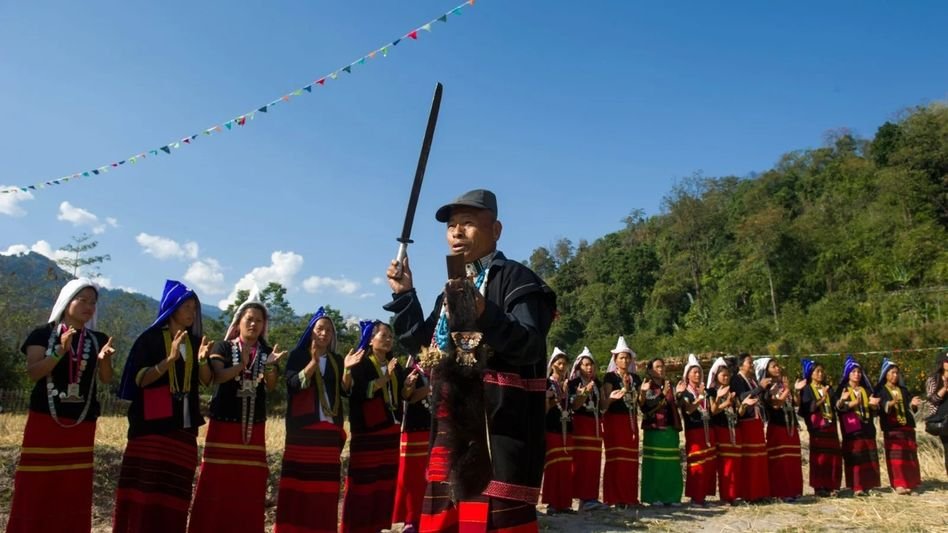
One of the most visually striking parts of the celebration is the Ponung dance. Performed by Adi women as part of the traditional festivities, Ponung is not just entertainment — it is storytelling through movement, a living thread connecting the present generation to every ancestor who danced before them. To watch it is to understand, even briefly, what it means to belong somewhere so completely.
The festival reflects the community’s deep connection with agriculture, nature and indigenous traditions, bringing families and communities together in celebration and thanksgiving. In an era where modernisation is rapidly reshaping lives across Northeast India, Solung serves as a powerful reminder that identity does not have to be abandoned to embrace progress. The Adi community has always known how to hold both.
CM Khandu’s gesture this Solung is part of a broader pattern — of leadership that chooses cultural acknowledgement over indifference. Whether it is a social media post or a public address, when the head of a state pauses to honour a community’s traditions in their own language and spirit, it signals something important: that no culture in Arunachal Pradesh is too small or too remote to be seen.
Solung is more than a harvest festival. It is a declaration — that the Adi people are here, they are rooted, and every September, they will remind the world of that, one Ponung beat at a time.