
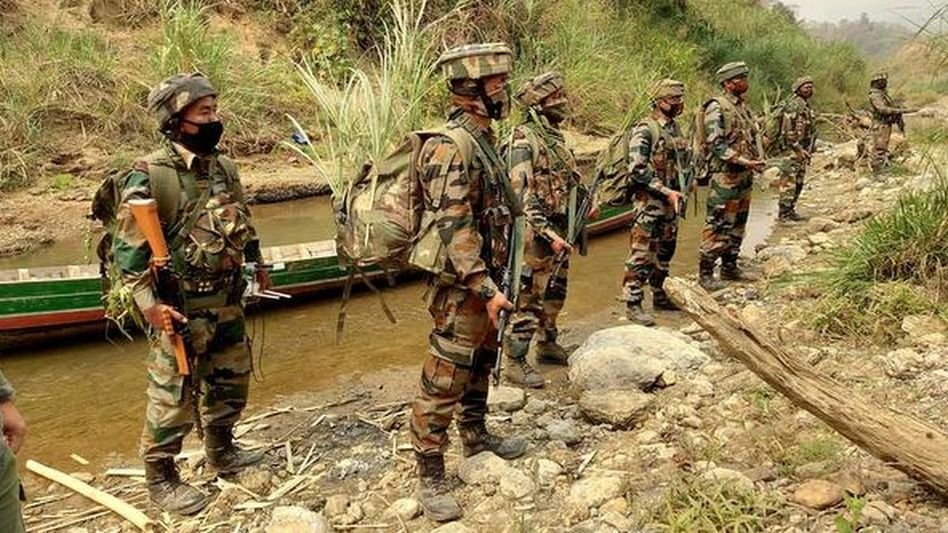
The sun had barely risen over the hills of Changlang when the gunfire broke the silence. At around 6:30 in the morning on September 29, a patrol team from the 21 Assam Rifles was moving through a stretch of land near Nampong — an area where border fencing work is actively underway along the India-Myanmar frontier. They never saw it coming.
The ambush left one soldier dead and four others wounded. And by the next day, not one but two militant outfits were openly claiming they pulled the trigger.
NSCN (K-YA) — the Nationalist Socialist Council of Nagaland (Khaplang-Yung Aung) faction — and the Revolutionary People’s Front (RPF) jointly issued a statement taking responsibility for the attack. The coordinated claim is significant. It points to a level of operational collaboration between the two outfits that security agencies will now have to seriously factor in.
The man who lost his life was Havildar Jankhokai Kuki, 42 years old. A serviceman in the prime of his career, killed while doing his job in one of the most challenging and high-risk postings in the country. Four of his colleagues were rushed to hospital with injuries. Their conditions, at last count, had not been officially disclosed.
Changlang has long been a pressure point. The district shares a porous border with Myanmar, and insurgent outfits have historically used that geography to their advantage — crossing in and out, regrouping, rearming, and striking when the opportunity arises. The ongoing border fencing project, meant to tighten that very perimeter, may itself be a flashpoint. Militants often view such infrastructure as a direct threat to their movement corridors, which could well explain the timing of this attack.
Following the ambush, Changlang Superintendent of Police Kirli Padu confirmed that security operations in the area had been scaled up significantly. Troops are now combing the region trying to track those responsible. It’s a familiar script in this part of the Northeast — an attack, a crackdown, a hunt through dense jungle terrain where the lines between forest and border blur dangerously.
What stands out here, though, is the boldness of the public claim. Outfits don’t always step forward after attacks like this. When two groups do so jointly, it signals something — a desire to assert relevance, perhaps, or to send a message to both the state and rival factions. Either way, it puts the spotlight squarely back on the India-Myanmar border as a zone of active, unresolved conflict.
Security forces have been ramping up efforts along this frontier for months, with the fencing project serving as both a physical and symbolic barrier. But infrastructure alone cannot substitute for intelligence-led operations in terrain this difficult. The Changlang ambush is a stark reminder of that.
Havildar Jankhokai Kuki was 42. He had a name, a rank, a life that extended far beyond the uniform he wore. As operations intensify in the jungles of Changlang, his family is left to grieve a loss that no press statement or security briefing can adequately explain.
The border waited in silence before dawn. It rarely stays that way for long.