


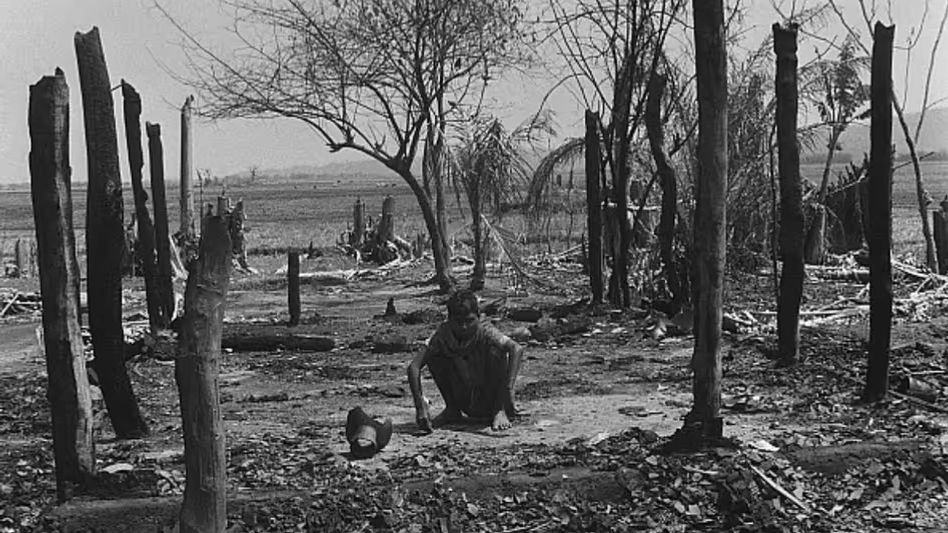
Prominent citizens and civil society leaders have issued a strong caution to the Assam government against politicising the long-buried Tewary Commission Report on the 1983 Nellie massacre, emphasising that selective or inflammatory use of its findings could reignite communal tensions rather than foster resolution on illegal migration and indigenous safeguards. The appeal came during a public discussion organised by a digital platform that recently procured the suppressed document through the Right to Information (RTI) Act.
The Assam Cabinet has approved the circulation of report copies among legislators during the upcoming Assembly session. However, Chief Minister Himanta Biswa Sarma has clarified that no formal debate on the report will be permitted in the House, a move intended to prevent escalation but which has nonetheless sparked concerns over potential misuse.
Historical Context: The 1983 Nellie Massacre and Assam Agitation
The Nellie massacre remains one of the darkest chapters in Assam’s history, occurring amid the height of the Assam Agitation (1979–1985) – a mass movement against illegal immigration from Bangladesh that sought to protect the state’s indigenous identity and resources. On February 18, 1983, in the wake of controversial elections held under President’s rule, over 2,000 people – predominantly Bengali-speaking Muslims – were killed in a matter of hours in Nellie and surrounding villages in Nagaon district. The violence, often described as one of the worst pogroms in independent India, displaced more than 2.26 lakh individuals and forced over 2.48 lakh into relief camps.
The Tewary Commission, headed by a senior bureaucrat from outside the state (then Additional Chief Secretary of Bihar, T.C. Tewary), was appointed to probe the statewide violence triggered by the elections. Its comprehensive report documented 8,019 incidents of unrest across Assam, resulting in 2,072 deaths. Notably, it concluded that the violence lacked any singular communal character, with triggers varying by district – from electoral malpractices to local rivalries and administrative lapses. Speakers at the discussion lamented that the entire state machinery was overwhelmed with conducting the polls, leaving little room to anticipate or contain the outbreaks. “Nobody really knew where and why violence was erupting,” observed veteran journalist Bedabrata Lahkar.
The report, submitted in the mid-1980s, was never tabled in the Assembly and languished in government archives for nearly four decades, symbolising the unresolved grievances of the Assam Agitation. Its resurfacing coincides with renewed debates on the Assam Accord (1985), particularly the unfulfilled Clause 6, which promises constitutional safeguards for Assam’s indigenous communities.
Current Developments: Resurfacing Amid Migration Debates
The digital platform’s RTI application has thrust the Tewary Report back into the spotlight, revealing its detailed accounts of the chaos and calling for its judicious use. While the government’s decision to share it with MLAs is seen as a step towards transparency, critics fear that cherry-picking excerpts – especially those linking the violence to immigration – could stoke divisions in a state already grappling with Citizenship Amendment Act (CAA) protests and border sensitivities.
Former Arunachal Pradesh Governor and ex-Assam Chief Secretary Jyoti Prasad Rajkhowa questioned the very framework of the inquiry: “A judicial commission should have been appointed… assigning the probe to a chief secretary-level officer from outside the state remains a question even today.” He added that releasing the findings four decades earlier “might have allowed some resolution of the problems.”
Senior advocate Santanu Barthakur underscored the report’s roots in immigration woes: “The background to the Tewary Commission is immigration.” He warned that “discussing isolated sections could trigger a seriously adverse reaction,” urging the government to prioritise addressing public anxieties over illegal migration and expediting Clause 6 implementation.
Key Statements and Collective Call to Action
The discussion, attended by intellectuals, activists, and journalists, resonated with a unified message: the report must serve as a tool for policy-making and healing, not political point-scoring. Bedabrata Lahkar highlighted administrative failures: “The entire administrative machinery was preoccupied with conducting the elections… the report correctly noted that the violence lacked any specific communal character, with causes differing across districts.”
Collectively, the speakers asserted: “The issues that drove the Assam Agitation remain unresolved… the Tewary Commission Report should be used to inform policy and calm public concerns – not fuel political confrontation.” They called on the government to:
- Engage in inclusive dialogues with civil society and affected communities.
- Accelerate Clause 6 safeguards to protect indigenous rights.
- Avoid any narrative that could exacerbate ethnic or religious divides.
Conclusion: A Plea for Resolution Over Retribution
As Assam navigates its complex demographic challenges, the Tewary Report’s revival offers a rare opportunity for reckoning and reform. Citizens’ warnings underscore a broader imperative: in a diverse state like Assam, politicisation risks deepening wounds rather than mending them. With the Assembly session approaching, all eyes are on how the government balances transparency with sensitivity, ensuring the ghosts of Nellie do not haunt the present.
(Source: India Today NE)
