


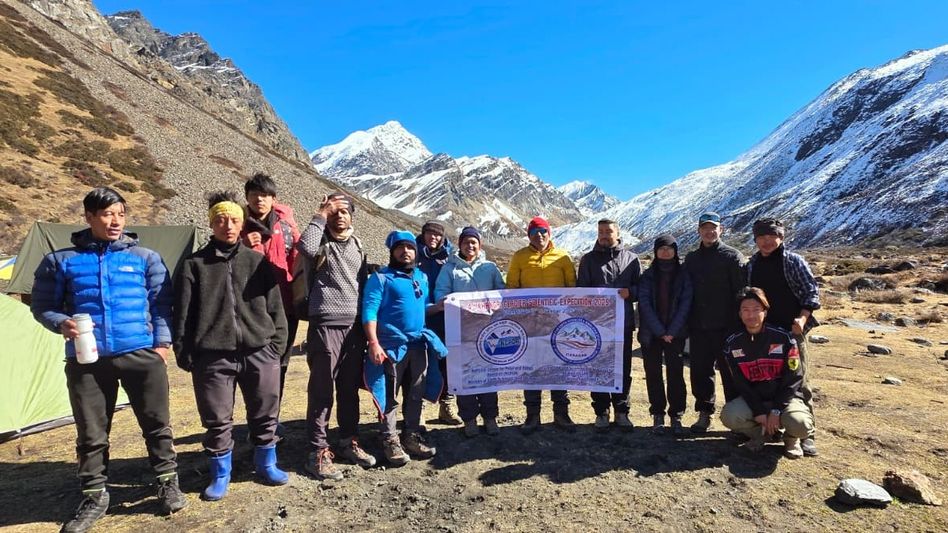
CESHS-NCPOR Team Masters Extreme Altitudes to Map Ice Retreat, Lake Hazards, and Climate Echoes in Mago Chu Basin
The fourth Khangri Glacier Expedition has triumphed over the Arunachal Himalaya’s unforgiving embrace, delivering a wealth of pioneering data on glacial dynamics and environmental shifts that could reshape regional resilience strategies. Led by the Centre for Earth Sciences and Himalayan Studies (CESHS) in tandem with the National Centre for Polar and Ocean Research (NCPOR), the mission braved sub-zero blasts, treacherous crevasses, and relentless isolation to unlock secrets from the Mago Chu basin’s frozen vaults.
Nestled beneath the majestic Gorichen peaks, the expedition’s core squad—featuring glaciology luminary Dr. Parmanand Sharma and a blend of engineers, scientists, and field specialists—pushed boundaries in one of India’s least-charted cryospheric frontiers. Over grueling weeks, they conducted hands-on assessments of ice mass balance, glacial velocity, and supraglacial lake vulnerabilities, painting a vivid portrait of how warming trends are accelerating retreat and amplifying outburst flood risks.
CESHS Director Tana Tage lauded the team’s indomitable spirit amid conditions that tested human limits: howling gales capping 5,000 meters, equipment freezes, and logistical labyrinths far from supply lines. “These warriors didn’t just endure—they excelled, harvesting metrics that illuminate the Eastern Himalaya’s pulse,” Tage affirmed, crediting the fusion of NCPOR’s polar prowess with CESHS’s local acumen for breakthroughs like high-resolution velocity maps and equilibrium line altitude projections.
Key harvests include detailed sonar scans revealing lake bathymetry and sediment loads, critical for forecasting glacial lake outburst floods (GLOFs) that threaten downstream lifelines. The mission also gauged supraglacial debris impacts on melt rates, offering fresh lenses on how surface clutter modulates ice loss in this understudied arena. These findings, poised for peer-reviewed dissemination, will refine predictive models and inform adaptive measures for Arunachal’s four glacial basins—Manas, Subansiri, Kameng, and Dibang—spanning over 223 square kilometers of ice.
Amid the rigor, the team wove in capacity-building threads, mentoring emerging scientists from Nagaland University and NERIST on drone surveys and geophysical tools. This knowledge transfer not only amplifies Northeast expertise but also sows seeds for sustained Himalayan monitoring, where data scarcity has long hindered proactive stewardship.
The expedition’s haul transcends numbers—it’s a clarion for urgent action, arming policymakers with intel to shield Brahmaputra-fed ecosystems and communities from cascading climate perils. As the squad returns, their odyssey stands as a beacon of scientific valor, proving that in the face of nature’s fury, human ingenuity can illuminate paths to preservation.
Edited by: Keshav Pathak
Relevant Tags
Arunachal Glacier Expedition, Khangri Mission Insights, Himalayan Cryosphere Data, CESHS NCPOR Collaboration, Glacial Retreat Arunachal, GLOF Risk Assessment, Mago Chu Basin Study, Ice Mass Balance Northeast, Climate Adaptation Arunachal, Scientific Gains Himalaya
Hashtags
#KhangriExpedition #ArunachalGlaciers #HimalayanScience #CryosphereInsights #CESHSNCPOR #GlacierRetreat #GLOFRisks #NortheastClimate #IceResearch #ArunachalPride
