


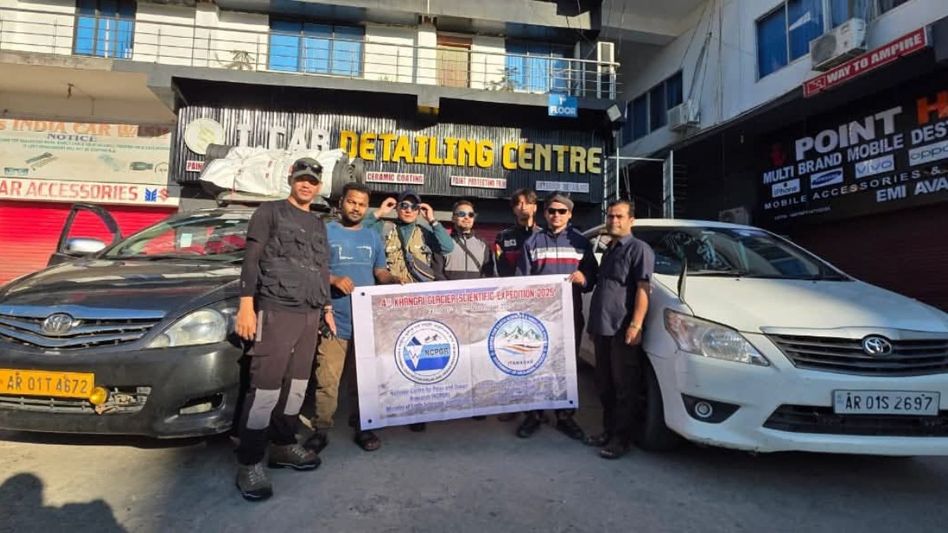
CESHS and NCPOR Unite for Pioneering Cryosphere Probe in Mago Chu Basin, Targeting Mass Balance Insights and GLOF Hazard Assessments
A trailblazing scientific venture has taken flight in Arunachal Pradesh, with the fourth iteration of the Khangri Glacier Expedition setting out to decode the evolving secrets of the Arunachal Himalaya’s frozen realms. Spearheaded by the Centre for Earth Sciences & Himalayan Studies (CESHS) in collaboration with the National Centre for Polar & Ocean Research (NCPOR), this immersive fieldwork plunges into the heart of the Mago Chu basin, cradled by the towering Gorichen peaks, to illuminate the impacts of climate variability on vital ice formations.
At the helm stands Dr. Parmanand Sharma, a trailblazing Scientist G and foremost authority on glaciology in India. His elite cadre comprises a fusion of domain experts and technical wizards: from CESHS, engineers Nyelam Sunil, Vikram Singh, and Romik Tato, alongside Solai Yun; NCPOR’s Dr. Sandeep Kumar Mondal and Talawar Raghavendra Chandrappa; Nagaland University’s Dr. Manasi Debnath and Samikcha Rai; and NERIST’s Abhishek Pratap Singh and Chewang Thupte. This multidisciplinary squad is primed to harvest on-the-ground data that could redefine our grasp of regional ice behaviors.
CESHS Director Tage Tage illuminated the expedition’s profound urgency, noting the stark under-exploration of Arunachal’s icy expanses. “The Arunachal Himalaya lingers as a vast, uncharted ‘white spot’ in India’s cryospheric map. Only a handful of glaciers have undergone rigorous scrutiny to map their sensitivity to weather patterns, equilibrium states, and enduring evolutions,” he observed. Spanning 161 glacial bodies across roughly 223 square kilometers in four cornerstone basins—Manas, Subansiri, Kameng, and Dibang—these frozen sentinels anchor the Brahmaputra’s upstream lifelines, yet they evade sustained surveillance for equilibrium metrics or water flow analyses.
This odyssey anchors on three cornerstone pursuits: executing hands-on probes into glacial equilibrium and movements to pinpoint local discrepancies; gauging the Eastern Himalayan ice domain’s reactions to global warming trends; and scrutinizing high-altitude lakes for outburst flood vulnerabilities—a escalating peril in alpine zones. By delving into these facets, the team aims to forge a clearer picture of how retreating ice masses ripple through hydrological cycles and ecological balances.
The stakes soar high, as these glacier-nurtured watersheds underpin downstream vitality, from irrigation networks to community sustenance. Outputs from this foray hold the promise of groundbreaking revelations on the interplay of atmosphere, ice, and rivers, sharpening forecasts for glacial vitality and resource stewardship in one of the subcontinent’s most enigmatic highland frontiers. As the explorers navigate treacherous terrains, their harvest could steer adaptive strategies, fortifying Arunachal’s role in the national climate resilience mosaic.
Edited by: Keshav Pathak
Relevant Tags
Arunachal Glacier Expedition, Khangri Glacier Study, Himalayan Cryosphere Research, CESHS NCPOR Collaboration, Dr Parmanand Sharma Glaciology, Mago Chu Basin Exploration, Glacier Mass Balance Arunachal, GLOF Risk Assessment, Eastern Himalaya Climate Impact, Brahmaputra Basin Glaciers, Northeast India Ice Dynamics, Scientific Fieldwork Arunachal
Hashtags
#KhangriExpedition #ArunachalGlaciers #HimalayanCryosphere #GlacierResearch #CESHSNCPOR #ClimateChangeHimalaya #GLOFRisks #BrahmaputraWaters #NortheastScience #IceDynamics
