


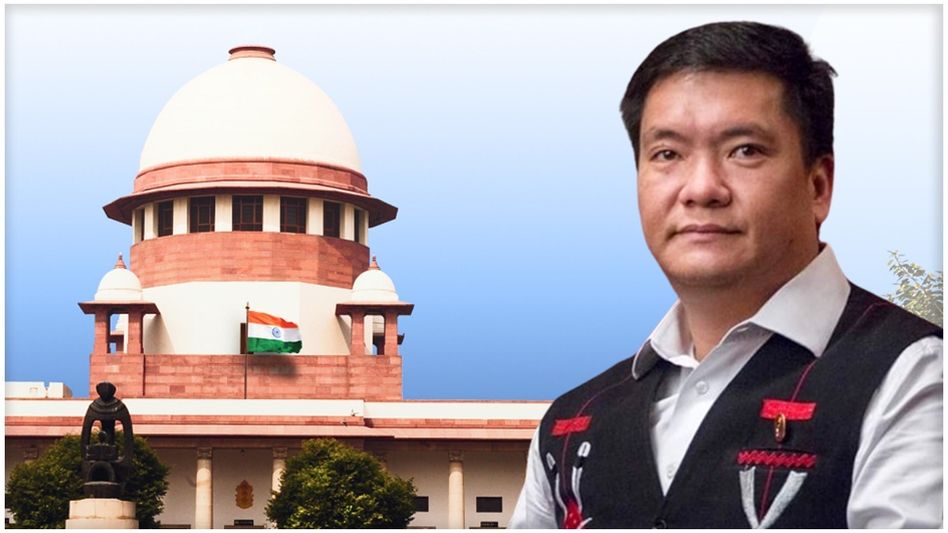
New Delhi – The Supreme Court of India has called for a detailed response from the Arunachal Pradesh government following a Public Interest Litigation (PIL) that accuses Chief Minister Pema Khandu of awarding lucrative public contracts to companies linked to his family members. The development marks a significant escalation in the scrutiny of governance practices in the northeastern state.
On Tuesday, a bench led by Chief Justice Sanjiv Khanna, alongside Justices Sanjay Kumar and K.V. Viswanathan, emphasized the need for transparency, directing the state to clarify the beneficiaries of these contracts and confirm whether proper procedures were followed. The court also sought responses from the Union Ministries of Home Affairs and Finance, as well as the Comptroller and Auditor General (CAG), within a five-week deadline, signaling a thorough investigation into the claims.
The PIL, filed by NGOs Save Mon Region Federation and Voluntary Arunachal Sena, alleges a pattern of favoritism, pointing to contracts awarded to firms associated with Khandu’s relatives, including his stepmother, Rinchin Drema, and nephew, Tsering Tashi. Notably, Rinchin Drema’s company, Brand Eagles, is said to have secured numerous government projects despite an apparent conflict of interest. The petitioners argue that such allocations undermine principles of fair governance, suggesting that these dealings could not have occurred without the Chief Minister’s direct involvement.
Adding historical context, the plea references the tenure of Khandu’s late father, Dorjee Khandu, who served as Chief Minister until his death in 2011. It claims that similar practices of channeling contracts to family-run entities persisted under his leadership, with the Department of Relief and Rehabilitation—overseen by both father and son—being a focal point for these awards.
The state government has pushed back, dismissing the PIL as politically motivated and an attempt to obstruct development. Its counsel argued that Arunachal Pradesh operates under unique circumstances and adheres to legal norms, citing a CAG report that purportedly found no major irregularities. However, the Supreme Court bench insisted on concrete evidence, with the Chief Justice remarking that vague assurances would not suffice.
As the case unfolds, it promises to shine a spotlight on accountability and the integrity of public administration in Arunachal Pradesh, with implications that could resonate across India’s political landscape. The matter is slated for further hearing in late July, pending the submission of detailed affidavits from all involved parties.
